Whole Life Carbon and SEA’s 2030 Commitment
Scott Edwards Architecture is excited to announce that this March we completed our fourth year of reporting for the AIA 2030 Commitment. Over the last three years, we have focused on understanding the energy efficiency of our projects (2023), tracking and reducing embodied carbon (2024), and creating better tools and visuals to track our progress in real time towards achieving our sustainability goals (2025.) This year, we are excited to include whole life carbon as the concentration for SEA’s sustainability and reporting efforts.
What is Whole Life Carbon?
Whole life carbon is a phrase used to describe the greenhouse gas emissions produced over the entire lifecycle of a building, from construction through operation and end of use. Whole life carbon includes both operational carbon and embodied carbon. Operational carbon refers to emissions resulting from a building’s use, including heating, cooling, lighting, and equipment, while embodied carbon refers to the emissions resulting from the materials used to physically construct the building itself. Embodied carbon includes emissions from raw material extraction, transportation, manufacturing, building construction, maintenance, and end-of-life. Together, operational carbon and embodied carbon make up whole life carbon.
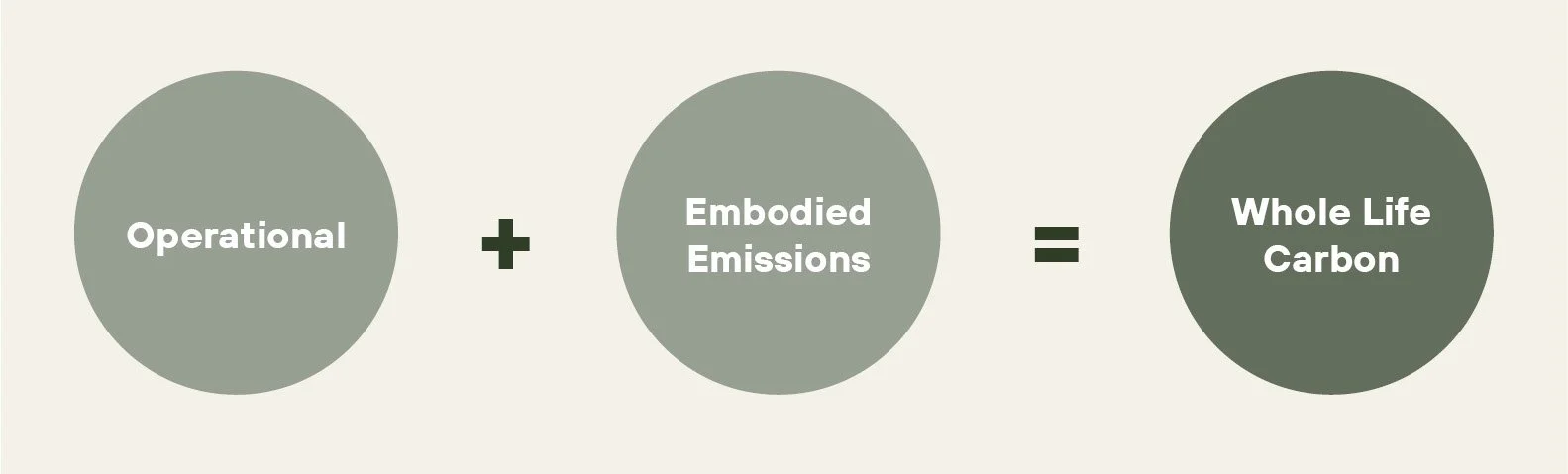
Considering whole life carbon is becoming increasingly important for the building industry.This more holistic view of building emissions is insightful at a time when codes have greatly improved building energy efficiency and the electrical grid is becoming cleaner. Using whole life carbon analysis, design teams can quickly understand whether it’s more valuable to invest in performance strategies, electrification, or both. It also allows for the calculation of trade-offs between operational and embodied emissions, essential for finding the design options with the smallest possible environmental impacts. For example, whole life carbon studies may demonstrate that the operational emissions savings of a high performance system don't outweigh its increased embodied emissions over the building’s life. Since the majority of embodied emissions occur before the building is operational, reducing these is critical to mitigating climate impacts today.
Our Carbon Accounting Process
SEA implemented whole life carbon accounting across our portfolio by using a combination of staff education, the web-based platform C.Scale, and a dedicated intern (made possible through a Net Zero Emerging Leaders Internship with Energy Trust) to serve as a key resource and provide analysis. For education, we shared a presentation on our AIA 2030 Commitment, its importance, and the reporting process during an all-staff meeting. We updated our reporting tool, a simple spreadsheet connected to a dashboard that displays progress metrics in real-time. All resources were made available to staff on our intranet, including step-by-step benchmarking and logging instructions.
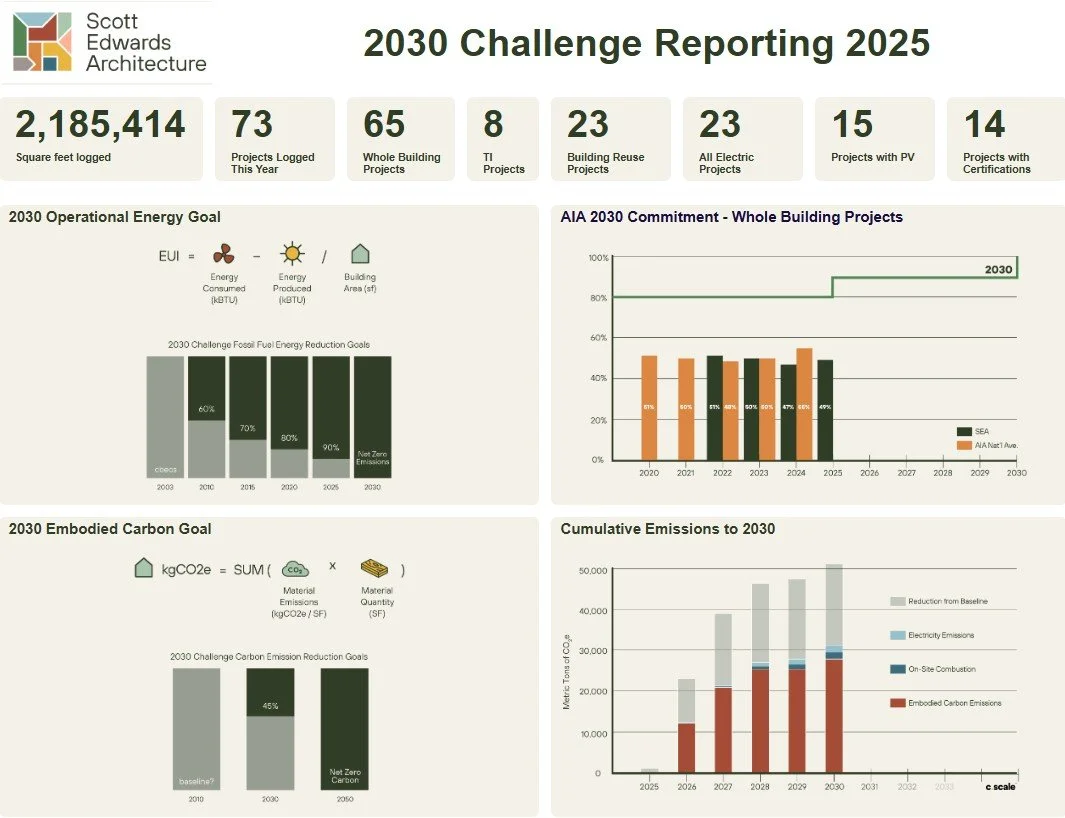
To gain a snapshot of whole life carbon for projects across our portfolio, staff learned to use the online platform, C.Scale. With a few simple quick inputs, C.Scale allows users to look at embodied carbon and operational carbon at the same time, track design modifications like changes in materials or building area, and compare similar projects. Our intern met with individual project teams to walk them through the C.Scale logging process making sure project data was input consistently and accurately, and staff came away being able to use the tool effectively on their own on other projects. By distributing training and tools across the office, we were able to model whole life carbon for 45% of the square footage we reported to the AIA 2030 Commitment this year, or a total of more than 975,000 sf! This represented 2 to 3 projects from each of our 9 market sectors.
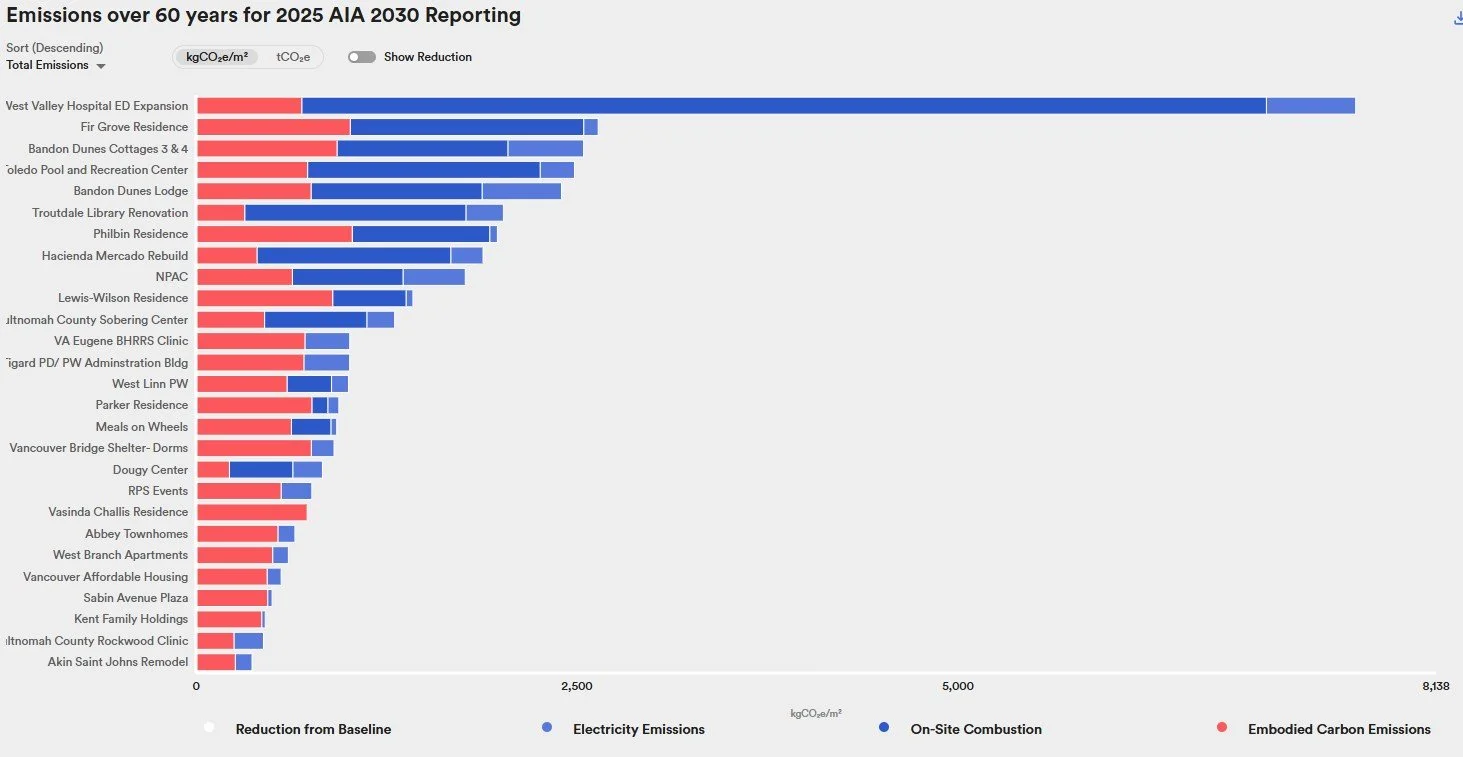
Our biggest lesson was the positive impact of building electrification. Across our portfolio, all-electric projects generally had lower life-cycle emissions. Even typologies like healthcare, which generally have high energy use intensity, had low operational emissions due to cleaner power, and these emissions will continue to drop as the electrical grid decarbonizes. Our C.Scale analysis allowed us to see that over the life of these projects, these savings add up. Prioritizing electrification for the healthcare and other high-energy-use sectors offers a great positive impact.
Since all-electric projects had lower operational emissions, we noticed that their embodied emissions were proportionally at least two times greater over the building life. For an all-electric project on the path to net zero energy, embodied emissions were nine times greater! Building electrification provides more impetus for prioritizing embodied carbon reductions, and our analysis of embodied carbon provided us with a few key insights.
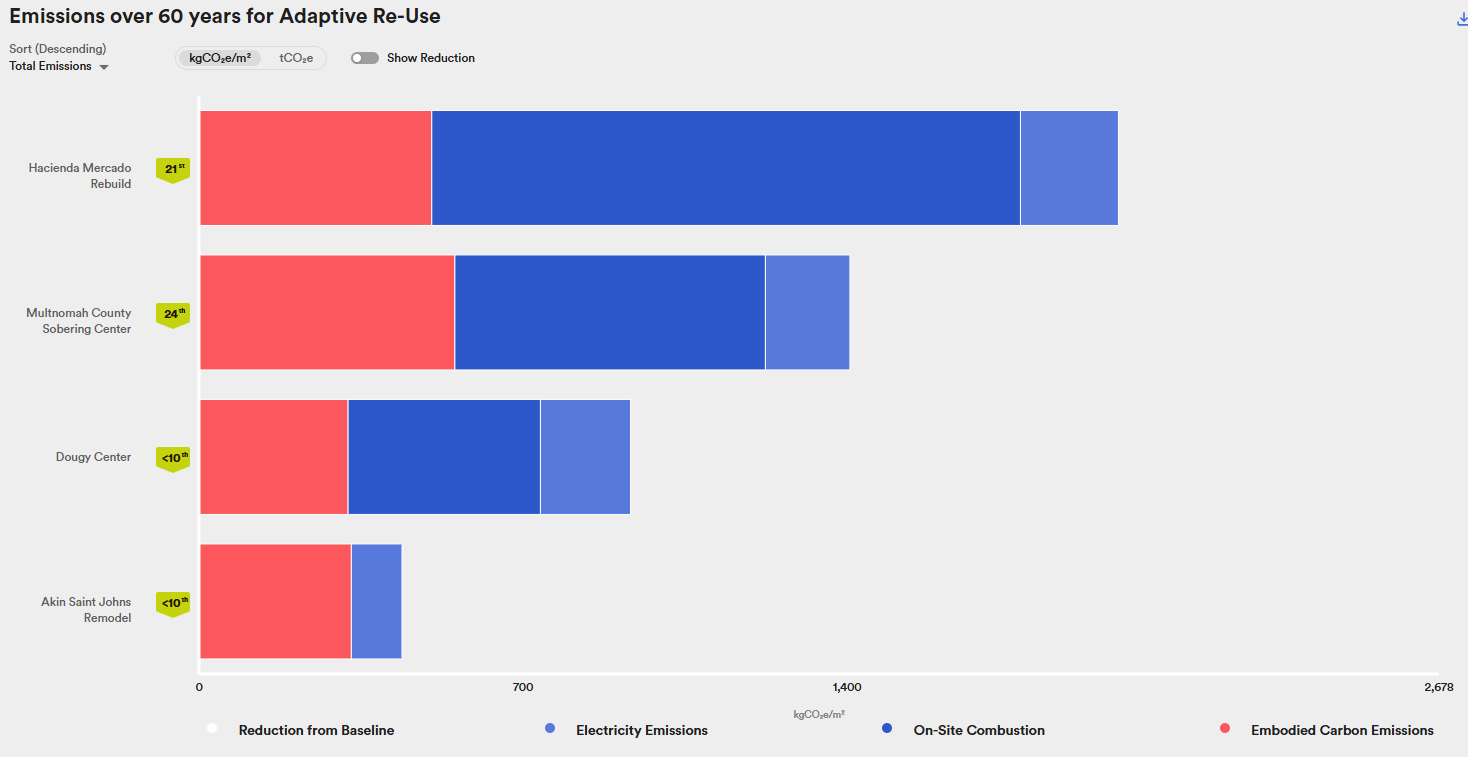
Adaptive reuse of existing buildings had the greatest impact, reducing embodied emissions by 50-75%. The six adaptive reuse and renovation projects we analyzed had the lowest overall embodied emissions within our portfolio. In contrast, projects with the highest embodied emissions were primarily those with more complex forms resulting in greater perimeter area. These projects often used steel and concrete primary structural systems, had greater amounts of glass per wall area, and featured heavier enclosure systems like brick, stone, or concrete. Also of note, a pre-engineered metal building serving as a dorm for a homeless shelter had 45% more embodied emissions when compared to light-wood-framed counterparts.
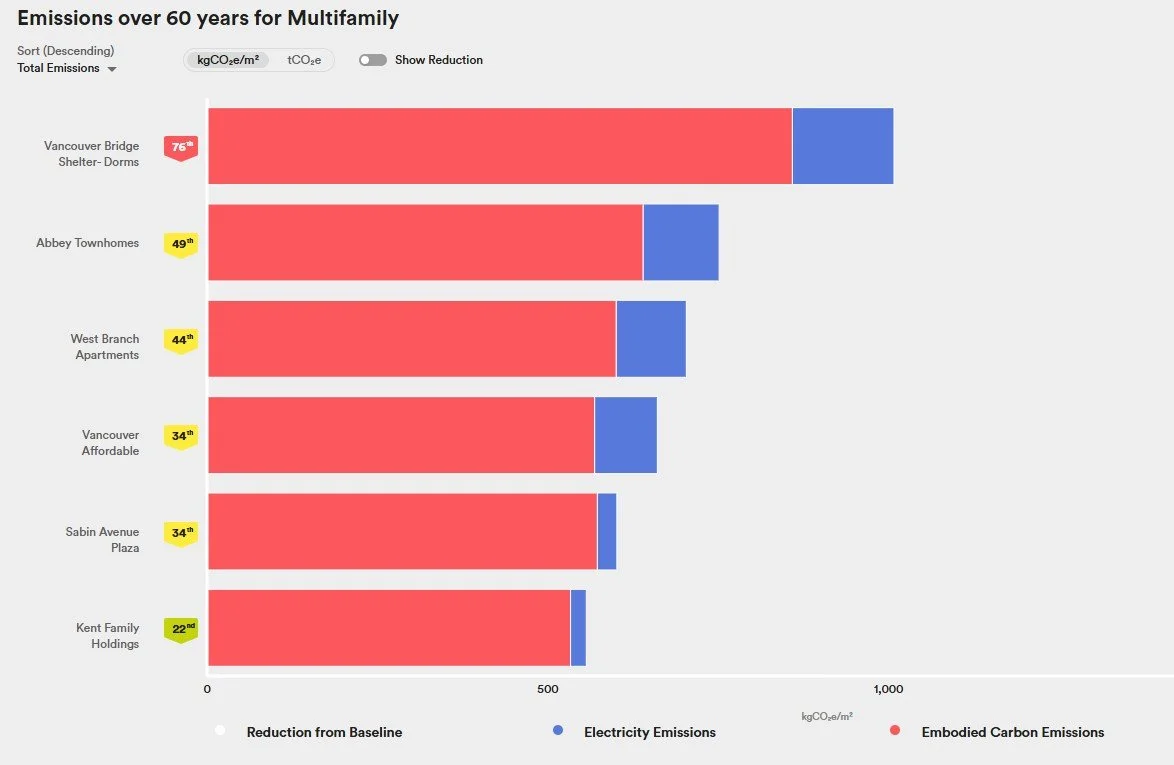
Borrowing lessons from affordable multifamily housing, our market sector with the lowest whole carbon emissions, offers insight into best practices. These projects had lower embodied carbon, mainly attributable to light-wood framing structural systems, simpler forms, lighter-weight enclosure materials, and reasonable amounts of glass. Operational emissions were low largely due to electrification, but also because of high-efficiency systems like mini-split heat pumps and centralized heat pump hot water heating. The combined effect of these operational and embodied emissions reduction strategies gets us closer to the Architecture 2030 goal of net zero carbon by 2050.
Simple Steps to Reduce Whole Life Carbon
Many of our takeaways from this process can be summarized in the following palette of strategies for reducing a building’s whole life carbon:
Educate staff and firm leadership
Employ energy and carbon modeling tools early and iteratively
Go all-electric
Promote adaptive re-use
Prioritize low carbon wood structural systems like mass timber and natural or biobased materials
Keep glass to no more than 25-30% of the total wall area
Design simpler massings to reduce building perimeter
Next Steps
The holistic lens provided by whole life carbon is at the heart of SEA’s 2030 Commitment and sustainability goals for 2026. This year, we are doing a deep dive into the AIA Materials Pledge, an initiative calling for firms to evaluate materials based on a framework of five pillars: human health, climate health, ecosystem health, social health & equity, and circular economy. Currently, we are investigating the “climate health” pillar, which focuses on materials that reduce carbon emissions and ultimately sequester more carbon than they emit. We are excited to explore the synergies between low-carbon materials, human health, and SEA’s people-first design philosophy and apply this knowledge to reduce the whole life carbon across all of our projects.